In this guide
At a glance
What this guide helps you decide
A practical guide to using Audible for college: edition matching, unabridged status, citations, note-taking, accessibility, and membership value.
Audible is most useful as a format choice for narrative material or as a supplement to visual text. Before subscribing or buying, verify that the recording matches the assigned work and that your study method captures evidence you can use in class, papers, and exams.
Match more than the title
Confirm author, translator, edition, abridged or unabridged status, narrator, publication details, and any accompanying PDF. A Shakespeare play, translated classic, or historical work can have materially different editions. A summary or lecture series is not the assigned text.
If the syllabus cites pages, ask whether chapters or timestamps are acceptable. Audiobooks may omit page numbers, illustrations, footnotes, bibliographies, exercises, or tables. When the course requires those elements, keep access to the assigned print or digital edition.
Use audio according to the material
| Course material | Likely role | Critical check |
|---|---|---|
| Novel, memoir, or narrative history | Often useful | Confirm the required translation or edition and keep a citation method. |
| Dense science or math textbook | Usually supplemental | Equations, diagrams, tables, and problem sets need visual access. |
| Language course | Potentially useful | Narration helps listening practice but may not match instructional audio. |
| Exam review while commuting | Useful for reinforcement | Do not make first exposure to complex material entirely passive. |
Build an active listening workflow
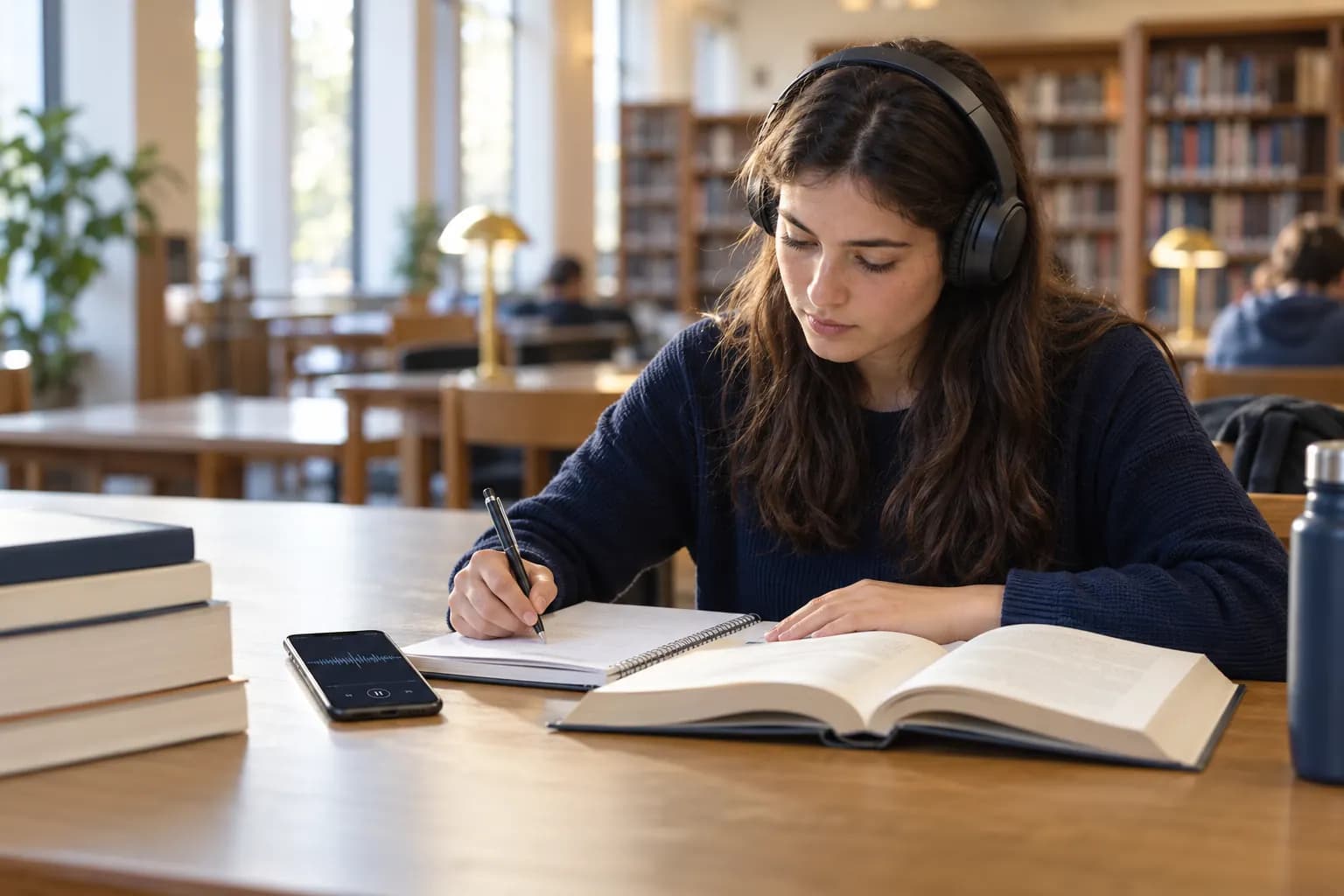
- Preview the assignment and identify names, terms, and questions before listening.
- Use bookmarks or notes for important passages and record the timestamp immediately.
- Pause after each section to summarize the argument from memory.
- Review difficult passages in print or synchronized text when available.
- Transfer useful evidence into course notes with complete citation details.
Playback speed can save time only while comprehension remains stable. For unfamiliar theory or technical material, repeated rewinding often erases the apparent benefit of faster playback.
Accessibility and convenience are real forms of value
Audio may help students with print disabilities, visual fatigue, migraines, long commutes, or attention that improves with combined listening and reading. Campus disability services and accessible-format programs may offer required materials without a commercial subscription, so check those options first.
Stronger fit
Narrative assignments, verified editions, repeat listening, and a reliable note-and-citation process.
Weaker fit
Diagram-heavy texts, page-specific discussion, required problem sets, or an uncertain edition match.
Evaluate the membership separately from the format
Finding one useful audiobook does not prove that a recurring membership is economical. Compare the current plan with buying the title individually, borrowing through your academic or public library, and using accessible course reserves. Count credits or catalog access only when they apply to books you will use.
Review current pricing, trial eligibility, credit rules, included-catalog access, cancellation, and what happens to purchased titles or unused benefits. A longer membership can reduce effective cost for a frequent listener while increasing waste for a student who needs only one assigned work.
Compare the three purchase paths
Begin with the academic requirement, then open the current Amazon terms for the option that matches your expected use. Campus Book Savings tracks these choices separately so future guidance can reflect which pathways students actually investigate.
Audible controls plan names, pricing, eligibility, benefits, catalog availability, and terms. Confirm all details on the destination page before enrolling or purchasing.
Editorial conclusion
Audible can be a strong supplemental study tool and, for some narrative assignments, a practical primary format. It should not replace visual access when the course depends on pagination, figures, equations, exercises, or exact editions. Match the work first, test comprehension, and judge any membership by titles actually used.
For a broader format decision, compare Kindle and print textbooks.
Audible for coursework FAQ
Can an audiobook replace an assigned textbook?
Only when the instructor permits it and the audio matches the assigned work. Many textbooks depend on figures, tables, exercises, equations, or page citations that audio cannot reproduce adequately.
What does unabridged mean?
It generally means the narration is not intentionally shortened, but you should still match the author, translator, edition, and included supplemental material to the assignment.
How do students cite an audiobook?
Follow the citation style required by the instructor and record chapter, section, timestamp, narrator, publisher, and edition details while listening. Ask how to handle page-specific assignments.
Is an Audible membership automatically cheaper?
No. Compare the current membership terms with the price of the exact audiobook, library access, and the number of eligible titles you will actually use.